
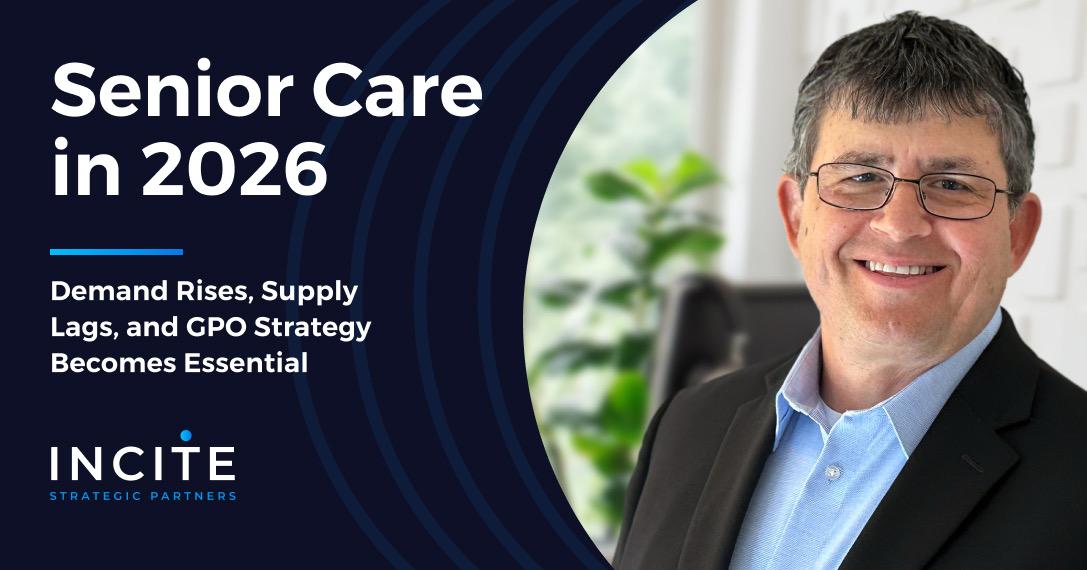
Author: Michael Dragone, Incite Strategic Partners, Co-Founder/President
Senior care is entering a new operating era. Occupancy and demand are rising while new supply remains constrained, workforce pressure persists, and families expect hospitality and clinical confidence at the same time. Execution and supply chain strategy, especially GPO strategy, are now central to growth, risk management, and experience consistency.
Occupancy Gains Accelerate Across the Continuum
The trend is unmistakable. In 3Q 2025, the National Investment Center (NIC) reported that U.S. senior housing occupancy rose to 88.7% – up from 88.0% the previous quarter and marking the 17th consecutive quarter of growth. Independent living reached 90.2%, assisted living climbed to 87.2%, and total occupied units increased from roughly 623,500 in 2Q 2025 to nearly 630,000 in 3Q 2025.
The momentum extends beyond traditional care settings. Active adult communities reported 92.1% occupancy in 3Q 2025, with properties open at least two years approaching 96% occupancy. This signals that “lifestyle-first” models are successfully expanding the top of the funnel for senior living – attracting residents earlier in their aging journey and building longer-term relationships that can transition naturally into higher-acuity care as needs evolve.
Supply is the Constraint – and it Looks Structural
New inventory is arriving slowly. NIC reported that fewer than 1,400 new units opened in 3Q 2025 and inventory growth was only 0.7% year over year. Construction is also at multi‑year lows: independent living and assisted living units under construction fell to roughly 17,000 combined in 3Q 2025 – levels last seen in early 2012.
Demographics amplify the imbalance. NIC MAP notes that between 2025 and 2030 the U.S. population aged 80+ is expected to grow by over 4 million, reaching about 18.8 million. It also estimates that, at current development rates, the U.S. would add 191,000 units by 2030 versus an estimated need of 560,000 – a shortfall of roughly 370,000 units.
The result: operators will compete on execution, not just location. NIC anticipates average senior housing occupancy could move above 90% by the end of 2026. In a supply-constrained market, pricing power will favor well-run communities, and families will have higher expectations for quality, consistency, and value. That shifts competitive advantage toward operators who can deliver reliable operations at scale, making supply chain strategy a core driver of differentiation.
Workforce and Regulation: Improving in Places, Uncertain in Others
Workforce remains the gating factor for both growth and quality. AHCA reported lower turnover in 2025 across multiple nursing home departments, including a sharp drop among top-level executives (from 31.97% in 2024 to 22.12% in 2025). CNA turnover—still the highest – remained 42.34% in 2025.
Regulatory expectations are also evolving. After the 2024 CMS rule established federal minimum staffing standards, the staffing-standard provisions have since been rolled back at the federal level via an interim final rule process announced in early December 2025. LeadingAge noted that other elements of the 2024 rule, such as enhanced facility assessment and Medicaid payment transparency reporting, remain in effect.
The leadership lesson for 2026: don’t build your quality strategy around a shifting regulatory floor. While regulators may shift, resident expectations won’t. With federal staffing mandates now uncertain, operators can’t rely on compliance alone to define quality. The most resilient strategy is to set internal staffing standards based on acuity, clinical outcomes, and staff development, and design operations that exceed regulatory minimums, even as those minimums change. That approach protects reputation, supports retention, and positions communities to compete on care quality rather than react to policy swings.
Where the Industry is Going
Four shifts are shaping planning cycles:
- Experience and outcomes are converging. Dining, hydration, engagement, and hospitality standards influence satisfaction and wellness.
- Acuity and coordination are rising. Residents are arriving with more complexity, requiring better integration with pharmacies, physicians, and discharge partners.
- Data is becoming operational currency. Leaders need timely visibility into labor productivity, food cost, and purchasing compliance – not month-end surprises.
- Senior care organizations are increasingly seeking to rely on GPOs as strategic advisors. Beyond pricing, operators are looking for group purchasing organizations that can provide category expertise, supply chain intelligence, and implementation support that drive consistency and protect margin across multi-site operations.
This is exactly why the supply chain is moving from “cost center” to “performance platform.”
The Growing Strategic Role of GPOs
Margin protection through standardization and adoption. Contracted pricing matters, but the bigger win is controlling variation and leakage. Savings that aren’t implemented at the community level don’t hit the P&L.
Resilience in a volatile supply environment. Diversified supplier portfolios, vetted alternatives, and category expertise help maintain service levels without sacrificing quality, which are critical capabilities as senior living leaders look to future-proof operations.
Speed and consistency across portfolios. Integration often breaks first in procurement—menus, specs, equipment, and vendor relationships. A modern GPO should accelerate alignment across dining, clinical, EVS, facilities, and admin while preserving smart local flexibility.
The best partnerships also help leadership teams move faster with better information: spend visibility, benchmarking, supplier performance reviews, and implementation support that turns “contract value” into adoption at the community level. As industry leaders like Fee Stubblefield and Angelo Papatheodorou have noted, strategic clarity around supply chain and operational execution is increasingly what separates high-performing organizations from the rest.
Practical Leaderships Tips of 2026
- Identify the “resident-impact” categories. Build a 12–18 month plan for the items and services that directly affect the resident experience.
- Measure contract compliance monthly. Treat it like census or labor hours—because it directly affects margin.
- Standardize the core, localize the signature. Standardize what drives cost and consistency; preserve flexibility for local identity and seasonality.
- Engineer dining like a strategic asset. Tie culinary decisions to satisfaction, wellness, and conversion, not just food cost.
- Create a cross-functional value analysis rhythm. Bring dining, clinical, finance, and operations together to align specifications, evaluate substitutions, and manage change.
- Choose GPO partners for capability – not just rebates. Implementation support, data tools, and value analysis resources are what convert “contract value” into real results.
Senior care is heading into 2026 with strong demand signals and a constrained supply backdrop. The organizations that win will be defined by repeatable execution—workforce stability, consistent care delivery, and an experience residents feel every day. In that environment, procurement discipline and GPO strategy are leadership tools.
About the author
Michael Dragone has been a successful leader and team builder in Dining and Foodservice roles for the past 35 years. For the last 20 years, he has been an accomplished collaborator and GPO innovator, bringing solutions throughout all segments of senior living. After earning his Associate’s Degree in Culinary Arts, Michael has spent his career driving value throughout the supply chain within healthcare and senior living, golf & ski, remote sites, and hospitality channels.