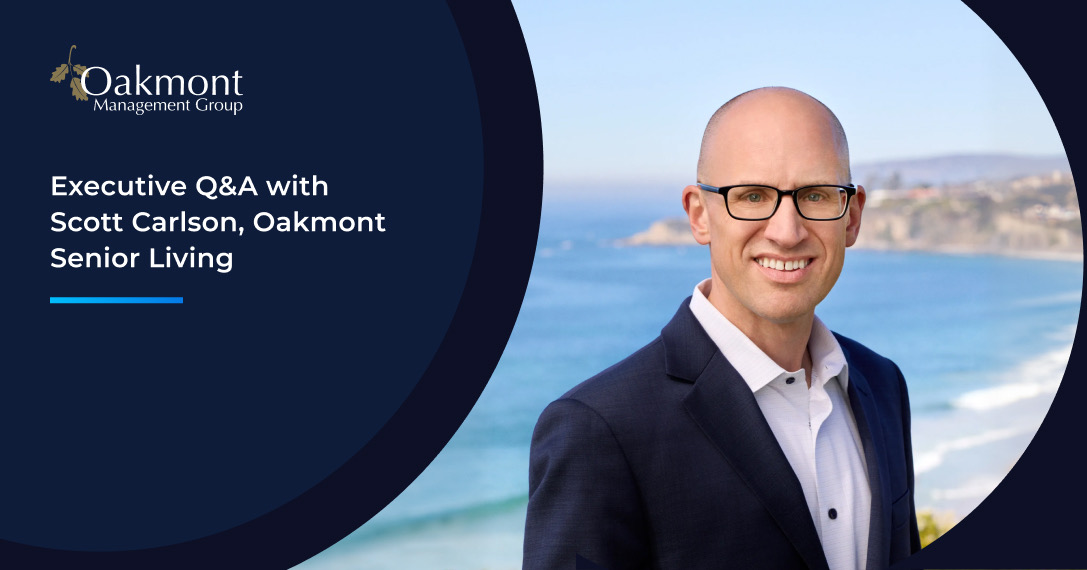
Scott Carlson knows that great leadership in senior living requires both heart and mind. As Senior Vice President of Operations at Oakmont Management Group, a best-in-class senior living organization operating Oakmont Senior Living and Ivy Living, Scott oversees more than 100 communities across the West Coast, leading teams to deliver exceptional results while maintaining a culture of excellence. With deep expertise in people strategy, operational leadership, and organizational development, he’s built a reputation for elevating performance without losing sight of what matters most: the residents, families, and team members who make each community thrive.
In this executive Q&A, Scott shares his philosophy on accountability, clarity, and the delicate balance between culture and results. From his approach to mentoring executive directors to his belief that “performance is our culture,” he offers strategic insights on what it takes to lead at scale and why serving four customers, not just one, is the key to sustained success. As a valued partner and customer, Oakmont Senior Living continues to set new standards in senior living, and Carlson’s leadership is a driving force behind that vision.
Q: Oakmont prides itself on a culture of excellence that goes beyond a mission statement. How do you define that culture, and how do you make sure it shows up in the day-to-day of each community?
A: At Oakmont and Ivy, performance is our culture. We pride ourselves on setting the standard for senior living and holding ourselves accountable to it. We are unapologetically driven to achieve results, and we believe that delivering excellence for our residents, families, team members and stakeholders requires nothing less.
To make that real day-to-day, we focus on clear goals and expectations and align our teams around the metrics that matter. Excellence becomes contagious when people see that culture and performance are inseparable.
Q: You often emphasize the importance of being clear with the organization’s goals and expectations. How do you encourage your teams to clearly define and align around the key performance indicators that matter the most?
A: To borrow the phrase from one of my favorite thought leaders, Brene’ Brown, Clear is kind. Anything unclear is unkind.
I truly believe people perform at their best when they know exactly what is expected and how success is measured. That’s why we focus on clear KPIs – like occupancy and financial results, – because these numbers tell a story.
When everyone is aligned on the same metrics, our performance conversations shift. They become less about opinions and more about meaningful progress. In other words, clarity helps us turn what could be subjective discussions into objective, forward-moving goals.
Q: You’ve said that a great executive director understands both culture and business. How do you train or mentor leaders to strike that balance?
A: The best leaders don’t choose between heart and mind, they use both. When I mentor executive directors, I push them to see that culture without results is empty, and results without culture are unsustainable. We train on financial acumen just as much as we coach on situational awareness. Leaders have to be able to read the room, and then flex their communication style accordingly. For example, I’ll walk a leader through how dining costs impact NOI, but I’ll also ask how their dining program makes residents feel. That tension, caring deeply about people while managing the numbers, is where exceptional leadership lives.

Q: You’ve identified four customers – residents, families, team members, and capital partners. Why is it important for executive directors to recognize all four equally?
A: Because success requires balance. If you over-index on one customer and neglect another, the system breaks down. Residents and families are why we exist. Team members are how we deliver. Capital partners give us the resources to keep raising the bar. A great executive director keeps all four in view, understanding that excellence for one customer group ultimately benefits the others. It’s not either/or, it’s all four, all the time.
Q: Accountability is critical in a culture of excellence. How do you help leaders hold their teams accountable in a way that is constructive rather than punitive?
A: Accountability works when it’s framed as support, not punishment. I tell leaders to approach accountability with the mindset of, “I want you to succeed, and I’ll be clear about what success looks like.” That means setting measurable goals, checking in consistently, and addressing issues quickly and directly. When people know expectations upfront, and trust that feedback is about helping them improve, accountability becomes a positive driver of performance rather than a fear tactic.
Q: What metrics or signals do you look for to know if a community’s leadership team is truly performing at a high level?
A: The headline metrics are occupancy and financial performance. Improving month over month, year over year. But underneath that, there are deeper signals: low turnover among staff, high family satisfaction, consistent compliance, and a team that is proactive rather than reactive. You know a leadership team is performing when the community feels energized, problems get solved before they become crises, and results are not one-time spikes but sustained excellence.
Q: With more than 100 communities, how do you foster collaboration and best-practice sharing among executive directors?
A: Scale can be our greatest advantage when we treat it as shared wisdom. We’ve built systems where best practices flow quickly, whether that’s through leadership summits, peer cohorts, or technology platforms that highlight what’s working in real time. But more importantly, we encourage leaders to pick up the phone and learn from each other. Culture spreads when leaders see themselves not as competitors, but as part of one high-performing team with a common goal.
Q: What’s the most common mistake new leaders make in senior living, and how do you coach them through it?
A: New leaders often think they have to do it all themselves — that their value is in solving every problem personally. The truth is, leadership is about building and empowering a team. I coach them to delegate, to trust, and to develop others. That shift from “doer” to “developer” is the biggest leap in leadership maturity. Once they embrace it, both their teams and their results accelerate.
Q: Group purchasing organizations (GPOs) can drive efficiencies without sacrificing quality. How do you see GPOs as part of an ED’s responsibility to manage both performance and culture?
A: A GPO is more than a cost-savings support system. A GPO, like Incite, is a way to align our communities on quality and consistency. An executive director who understands the value of a GPO sees it as a lever to deliver the same high standards at scale, while protecting resources that can be reinvested in team members and residents. Financial Stewardship! That is, stewarding the business wisely while upholding our culture of excellence.
Scott Carlson’s approach to leadership reminds us that clarity, accountability, and balance are the foundation of lasting success in senior living. At Incite Strategic Partners, we work alongside organizations like Oakmont Management Group to help streamline operations, protect resources, and elevate standards across every community. Contact us to discover how the right GPO partnership can amplify your impact.